
Gold Hydrogen: The Natural Hydrogen Colour
That’s Driving a Global Exploration Race
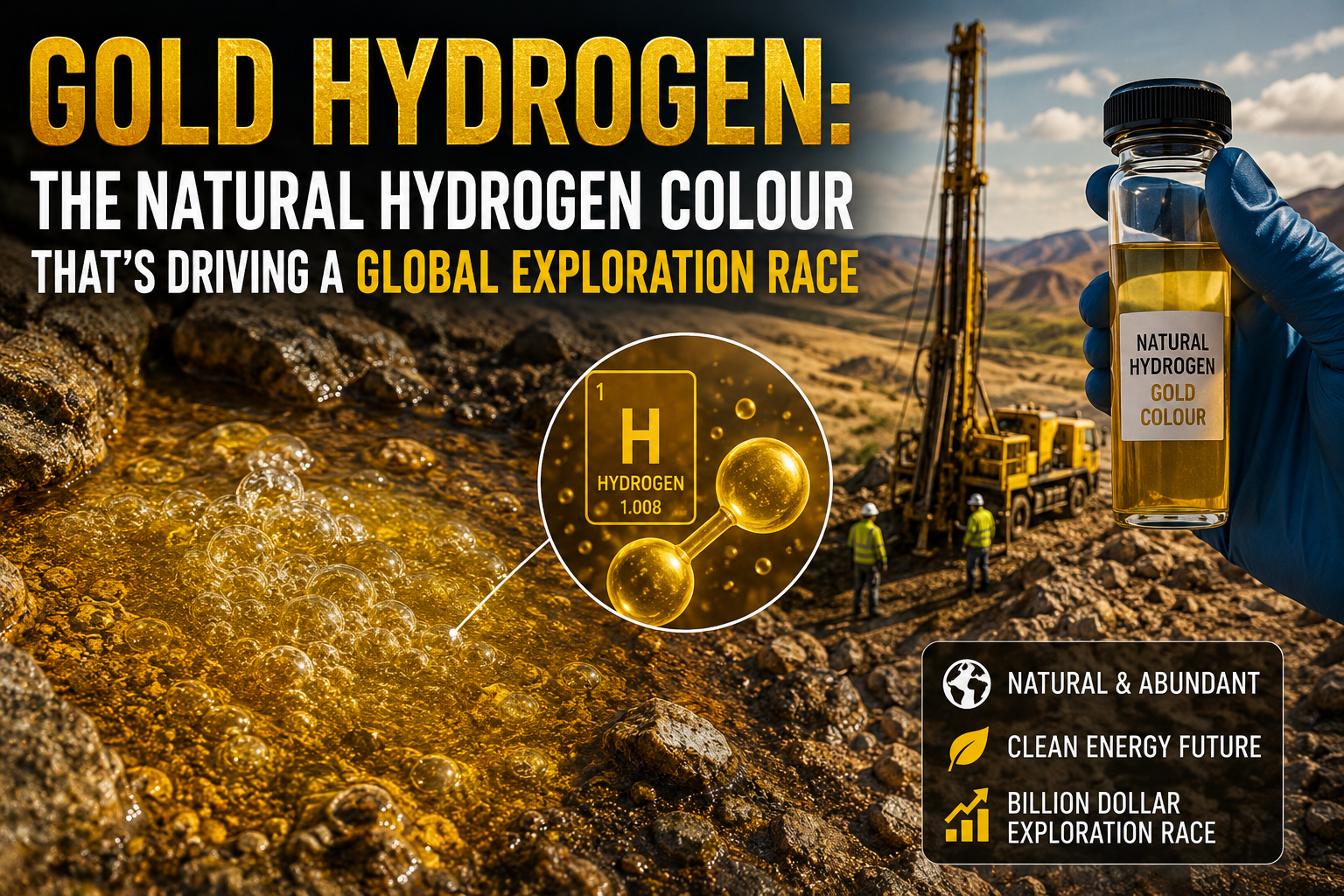
Gold hydrogen is naturally occurring geological hydrogen — the same substance as white hydrogen, natural hydrogen or geogenic hydrogen, depending on which scientific community is speaking. The term “gold” is used particularly in Australia and the USA, where Gold Hydrogen Ltd on the ASX has become the world’s leading listed natural hydrogen exploration company. In December 2025, Gold Hydrogen confirmed 97% purity hydrogen at its Ramsay 3 well in South Australia — one of the highest purity readings ever recorded for natural hydrogen anywhere in the world. The global exploration race is accelerating.
What Is Gold Hydrogen — And Why the Colour Name
The hydrogen colour spectrum — grey, blue, green, pink, turquoise — describes how hydrogen is produced, not the gas itself. Gold hydrogen refers to naturally occurring hydrogen produced by geological processes in the Earth’s crust, extracted directly from underground reservoirs like natural gas. The “gold” designation reflects its high value — a fuel that requires no electricity, no electrolysis, and no fossil feedstock to produce.
The term is used interchangeably with white hydrogen (dominant in French-language media and European policy), natural hydrogen (dominant in academic literature), and geological hydrogen. Natural hydrogen has been identified in many source rocks in areas beyond the sedimentary basins where oil companies typically operate. As of 2026, the scientific consensus is that enormous quantities exist globally — the question is whether they can be extracted economically at scale.
Gold Hydrogen Ltd — The World’s Leading Listed Explorer
Gold Hydrogen holds exploration licences over known occurrences of natural hydrogen in South Australia, with a vision to unlock one of the world’s sources of natural hydrogen and help the global transition to a decarbonised economy.
Gold Hydrogen confirmed purity levels of up to 97% at Ramsay 3, demonstrating continuation of the promising natural hydrogen and helium play. The well intersected multiple gas-bearing zones within the Parara, Kulpara, and Hiltaba formations, showing strong correlation with wireline log data and favourable porosity, fracturing, and fluid mobility characteristics. A Completions and Well Test Program in Q1 2026 assessed flow potential from multiple formations.

The Global Exploration Race — Key Players in 2026
- Gold Hydrogen Ltd (ASX: GHY) — Australia · Yorke Peninsula · 97% purity confirmed · largest listed pure-play natural H₂ company · Q1 2026 well test
- FDE / REGALOR II — France · Lorraine · 92 Mt estimated · 3,655m depth · commercial results expected 2027 · largest known deposit globally
- H2EX / CSIRO — Australia · Eyre Peninsula · PhD modelling programme · drilling targeted 2026 · 75% lower cost than manufactured H₂ projected
- Koloma — USA · raised $245M · largest private natural H₂ investment globally · Kansas and Nevada exploration
- MAX Power Mining — Canada · Saskatchewan · Genesis Trend · first Canadian natural H₂ drilling discovery confirmed January 2026
- BE.Hydrogen — Belgium · GSB geological survey · Wallonian coal basins · first evaluation spring 2028
- Mantle8 — Europe · €3.4M seed · 4D geological imaging technology for subsurface H₂ trap identification
Why Gold Hydrogen Could Cost $0.50/kg — The Economic Case
Company forecasts show the production cost of natural hydrogen at about 50 cents a kilogram, compared to an initial forecast of $3/kg to $9/kg for manufactured hydrogen. This cost advantage — if confirmed at commercial scale — is transformative for the entire hydrogen economy.
At $0.50/kg, gold hydrogen makes green synthetic fuels (e-petrol, e-kerosene, e-diesel, e-methanol) economically competitive without subsidies. It makes green ammonia competitive with fossil ammonia. It makes hydrogen fuel cells viable for heavy transport and backup power without government support. The Lorraine deposit in France — the largest known globally at 92 million tonnes — sits in the Greater Region adjacent to Belgium, Luxembourg and Germany, with planned HY4Link hydrogen pipeline infrastructure already in development.
Gold hydrogen is not a distant promise. It is an active exploration sector with listed companies, real wells and confirmed purity readings. The question for 2027 is whether REGALOR II in Lorraine will provide the first commercial-scale confirmation.
- → Gold Hydrogen Ltd — goldhydrogen.com.au — Ramsay 3 · 97% purity · December 2025
- → NatH2investing — “Gold Hydrogen Confirms 97% Natural Hydrogen Purity at Ramsay 3” — December 2025
- → Hydrogen Insight — “Australia’s first well tests for natural H2 begin” — March 2024
- → CSIRO — H2EX · Eyre Peninsula · natural hydrogen modelling — September 2025
- → Wikipedia — Natural hydrogen — updated 2026
- → TechXplore — “How natural hydrogen could serve as a new energy source” — February 2026
- → FDE / REGALOR II — Lorraine · Pontpierre 3,655m — October 2025